The argument
Compounding
A practice for senior operators under sustained pressure
I. The failure point you can’t see
A senior operator leaves a company. Sometimes by choice. More often, in this cycle, because the organisation is reorganising around AI, cost, or political fault lines they didn’t draw. The departure is logged. The role is backfilled. The org chart updates within a quarter.
What never gets logged is what actually leaves with them.
The texture of every client relationship they’ve held for a decade. The reasons certain decisions got made and certain others got vetoed. The shape of the trust they had built with the four people whose phone calls they actually returned. The pattern recognition they had developed over twenty thousand meetings about which problems would resolve themselves and which ones wouldn’t. The judgement.
None of this is in the handover document. None of it could be. It was never written down anywhere, because the operator carrying it didn’t know they were carrying it. That is how senior expertise works. It accumulates invisibly, gets rewarded for being invisible, and then walks out the door in a single afternoon.
This is the failure mode every organisation accepts as a cost of doing business. And nobody is pricing it.
II. The other failure point
There is a second way the senior operator fails, and it doesn’t require them to leave.
Under sustained volatility, the operator’s judgement narrows. This is not a character flaw. It is documented science. The brain under chronic threat optimises for survival. The aperture closes. Self-talk turns critical. The operator starts playing not to lose. Decisions get smaller. Risks that would have been taken in a steadier season get deferred. Relationships that should be invested in get treated as threats. The operator stays in the chair, but the version of them that built the thing is no longer the version sitting in it.
This is the experience that performance psychology has been describing in elite athletes for forty years. The science is settled. Under pressure, even the most capable performers default to constriction. The cure is not removing the pressure. It is training the operator’s relationship with it.
What performance psychology has not solved, and is not building, is the infrastructure layer that holds the operator’s context steady while they do that training. The psychology trains the mind. Nothing trains the system around the mind.
That gap is where most senior operators currently live.
III. Two failures, one risk
These look like different problems. They are the same problem.
In both cases, the senior operator is the single point of failure for context that no one else in the organisation can reconstruct. In the first, the context disappears with them. In the second, the context narrows along with their judgement under pressure. Either way, the value the organisation depends on becomes unavailable, and there is no backup.
Every senior operator carries four kinds of context that the organisation around them assumes will always be available:
Relationships: the actual texture of trust with the small number of people whose calls matter. This is not in the CRM.
Commitments: what the operator has promised, what has been promised to them, what is ageing, what is about to slip. This is not in any single tool.
Decisions: what was chosen, what was rejected, why, and what would change the answer. This is not in the meeting minutes.
Judgement: the pattern-recognition built across twenty thousand meetings about what matters, what doesn’t, what to interrupt, and what to absorb. This is not anywhere at all. It is the operator.
When the operator leaves, all four go. When the operator narrows, all four contract. The organisation in both cases continues to act as if the context is intact. It isn’t.
The standard response in 2026 is to expect the operator to absorb this risk personally. Work harder. Stay calmer. Be more resilient. Train your mindset. Read the books, do the breathwork, attend the offsite.
This advice is not wrong. It is incomplete. Telling a single point of failure to be more durable does not stop them being a single point of failure. A system has not been built around them. The risk has not been distributed. The context has not been externalised. The operator under pressure is being asked to do the work of an entire infrastructure layer with their own nervous system.
They will fail. Not because they are weak, but because the design is wrong.
Compounding is the practice that corrects the design.
IV. The moment
Volatility is not a metaphor.
In 2025 alone, 783 separate layoff events at technology companies cut 245,953 people. The opening months of 2026 have already added a further 95,878. These figures track only the named, counted events at named, counted companies. The actual number of senior departures across the broader knowledge economy (finance, media, consulting, advertising, professional services) is materially larger and is generally undercounted, because senior departures are usually announced as transitions rather than cuts.
Something else is worth noticing about these figures. The 2025 wave of cuts changed in character around mid-year. The earlier rounds were post-pandemic correction work: companies unwinding the over-hiring of 2020 and 2021. The later rounds were not corrections. They were strategic restructurings: organisations actively reallocating headcount budget toward AI development and reorganising around what AI was now capable of doing in place of people. By the end of 2025, AI was the most commonly cited reason for senior cuts.
This means the ground has shifted underneath the senior operator twice in eighteen months. First the bear market, then the AI displacement. The two waves overlap, and the operators who survived the first are now navigating the second. There is no version of this that resolves quickly.
The operator does not need to be told this is happening. They are reading the same news everyone else is. What this section has not yet explained is why the volatility is structural rather than cyclical, and why the response from the system that produced the volatility will not arrive in time. That is the next question.
V. The deflation argument
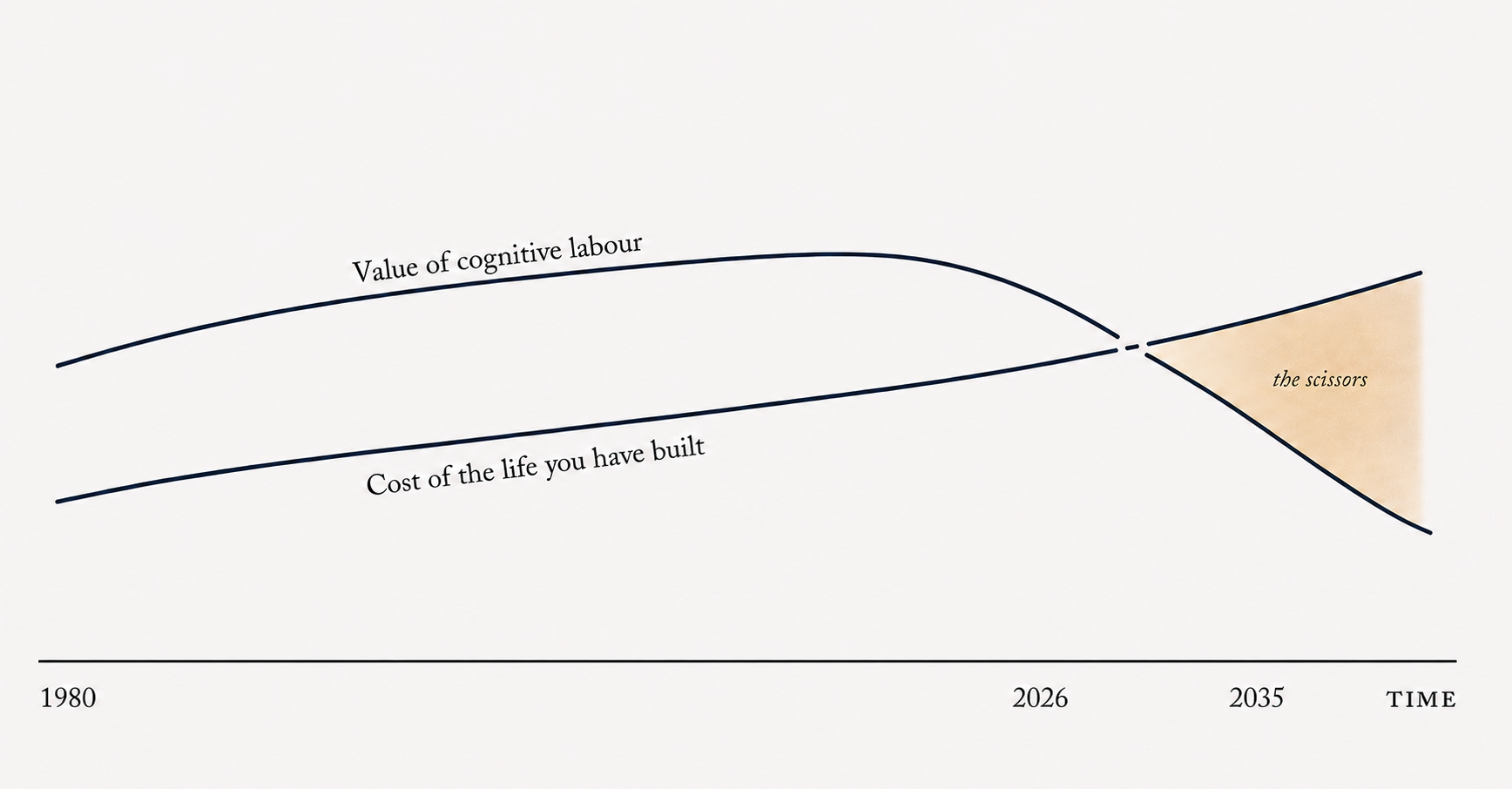
Senior operators are not the most exposed group in raw numbers. They are the most exposed group in concentration of risk. Their value is built on accumulated context, and context is what AI is currently most disruptive to, because most of it has historically lived in their heads. The heads, increasingly, are seen by their organisations as the expensive part. To understand why this re-pricing is structural rather than cyclical, the senior operator has to look at the economic system the cognitive professions were embedded in, and at what has just broken inside it.
For most of the twentieth century, the economic system the senior operator was born into ran on a quiet bargain. Productivity rose. Wages rose alongside it. The cost of the life a working family could build rose too, but slowly enough, and predictably enough, that rising income kept pace. The bargain had a name in the post-war academic literature, but the senior operator did not need to know it. They only needed to live inside it. The bargain held. Their parents bought a house. They bought a bigger one. Their children would buy bigger ones still.
The bargain was the absorption mechanism. Productivity gains, when they arrived from electrification, from the assembly line, from containerised shipping, from the personal computer, from the spreadsheet, from email, were absorbed by the system rather than collapsing it. The gains showed up as cheaper goods, but also as higher wages, expanded consumption, and a steadily rising price level. Inflation, modest and managed, was the mechanism by which the system distributed the dividend of technological progress across the workforce. Productivity went up; prices went up gently; wages went up roughly in line with prices; the worker, on net, came out ahead. The technology deflated the cost of producing things. The post-Keynesian system inflated the cost of everything else just enough to keep the workers whole.
This is what we mean when we call the post-war economic order Keynesian. Not the textbook caricature of stimulus and demand management, but the deeper structural commitment: the system runs on inflation, and inflation works because productivity gains feed wage growth, and wage growth feeds consumption, and consumption justifies the next round of investment. The whole machine breathes through the absorption of technological progress into rising household income. Take away the absorption mechanism and the machine stops breathing.
Technology, viewed in isolation, has always been deflationary. A loom does the work of ten weavers. A spreadsheet does the work of ten clerks. The cost of the underlying output collapses; the price falls; the consumer benefits. Left to itself, technology deflates everything it touches. What kept the post-war economy from spiralling into the deflationary trap that destroyed the 1930s was that the gains from each new technology did not stay where they fell. They were absorbed: into wages, into consumption, into the rising tide. The deflation was real. The absorption was the answer.
For seventy years, this was simply the climate the senior operator worked inside. They might not have articulated it. They did not need to. The houses got bigger. The schools got more expensive. The salaries got bigger too, just enough. The career delivered, in the long arc, what the career was supposed to deliver: a life one tier wealthier than the one before it.
Then the absorption mechanism broke.
It did not break suddenly. It had been weakening for decades, as the gains from automation increasingly accrued to capital rather than labour. Wages decoupled from productivity sometime in the 1970s; the trend held through every subsequent technology cycle. But the senior operator, working in the cognitive professions, was for a long time insulated from the decoupling. The deflationary pressure from each new technology fell on someone else. Manufacturing workers. Retail clerks. Travel agents. Bank tellers. The senior operator’s expertise, the judgement, the relationships, the accumulated context, the ability to read a situation and respond to it, was not yet deflatable. Their wages, accordingly, kept rising. The absorption mechanism, for them, still worked.
AI is the technology that ends the insulation.
What AI deflates is cognitive labour itself. Not the routine tasks at the edges of cognitive work; those have been getting cheaper for forty years. The core. The expensive part. The judgement, the synthesis, the pattern recognition, the writing, the analysis. The work that the senior operator was paid for, not because anyone could do it, but because they could do it well. The work that justified the salary. The work that justified the life the salary supported.
The deflation of cognitive labour by AI is not a forecast. It is observable in the labour market today. The 2025 cuts that this essay opened on were not accidents. They were the absorption mechanism’s first failure under the new pressure. The senior operators who lost their roles were not less competent than they had been the year before. The market for their competence had simply re-priced. The cognitive output they produced was now available at a fraction of the cost from a system that did not draw a salary, did not require pension contributions, did not need a corner office, and did not get tired.
Here is the structural break. In every previous technology cycle, the deflationary pressure from the new technology hit one part of the labour market while the rest of the economy continued to inflate. The displaced workers found new work, often in cognitive professions, which were the part of the economy where wages still rose. The aggregate system continued to inflate because the aggregate productivity gain continued to be absorbed by the parts of the labour force the new technology had not yet reached.
There is no part of the labour force AI does not reach.
The deflationary pressure is now general. It is hitting every cognitive profession simultaneously. The places the displaced senior operator was supposed to migrate to (consulting, advisory, fractional executive work, the long tail of knowledge work) are all subject to the same pressure. There is no insulated cognitive sector. The absorption mechanism has nowhere to absorb the gain to.
Meanwhile, the inflationary side of the system continues without modification. The mortgage continues. The school fees continue. The cost of healthcare continues. The cost of the life the senior operator built, calibrated to a salary curve that was supposed to keep rising, continues to rise on the schedule the post-Keynesian system established for it. Costs have not noticed that the absorption mechanism broke. They are still rising as if income would absorb them.
This is the scissors. One blade is the value of senior cognitive labour, which has bent downward and is falling at an accelerating rate. The other blade is the cost of the life that labour was meant to support, which continues to rise on its established curve. The two blades have crossed already, in the recent past, for an increasing number of senior operators. The space between them, the gap between what the operator can earn and what the operator’s life now costs, is the structural condition this essay diagnoses.
The scissors will not close on its own. There is no policy intervention currently being designed at sufficient speed or scale to restore the absorption mechanism. There is no career move available to the senior operator that takes them outside the deflationary pressure, because the pressure is general. There is no version of working harder that solves the problem, because the problem is not effort. The problem is that the value of the operator’s output, in the system’s current pricing, is falling faster than the operator can adjust the cost of their life downward.
The senior operator is therefore in a position the post-Keynesian system did not build them to occupy. The bargain they were born into is no longer being honoured. The technology that broke it is structural, not cyclical. The response, if there is one, will not come from the system. It will have to come from the operator. The remainder of this essay is the response.
VI. The psychology of operating under sustained pressure
Performance psychology has spent four decades studying what happens to expert performers when the stakes rise. The findings are consistent across domains: sport, surgery, military command, aviation, music, public performance. They apply to senior operators without modification.
Under acute pressure, the trained performer can rise. The body floods, the focus sharpens, and the well-rehearsed action delivers. This is the response everyone associates with high performance, and it is real.
Under sustained pressure, something different happens. The same physiological response, held over weeks and months, becomes the resting state. Cortisol stops being a signal and becomes the climate. The performer’s nervous system stops distinguishing between threats and ordinary signals. The brain (operating on a survival principle older than any executive function) begins to optimise for the avoidance of further loss rather than the pursuit of further gain.
This is when the aperture closes. The performer’s working memory shrinks. Their tolerance for ambiguity drops. Self-talk turns critical and repetitive. They stop noticing their own physical state, which means they stop noticing when their judgement is being shaped by it. They become more competent at the narrow thing in front of them and less competent at the wide thing behind it. They lose access to optimism: not as a mood, but as a cognitive state that allows them to imagine futures different from the present.
The research literature has names for each of these effects. Locus of control narrows from internal to external. Mindset shifts from growth to fixed. Flow states become rarer and shorter. Decision quality erodes in measurable ways. The performer, under sustained pressure, becomes a worse version of themselves while believing they are simply working harder.
Senior operators in the current cycle are operating under this pressure constantly. They have been for two years. Many of them will be for two more.
They do not need a productivity app. They need an environment that does not require them to hold the entire weight of their context with a nervous system that is no longer in a state to hold it.
VII. What performance psychology can and cannot do
The field has built a serious body of practice for working with this problem at the level of the individual mind. Mindfulness, self-talk discipline, optimism training, locus-of-control work, the deliberate cultivation of presence. These are real techniques with real evidence behind them. The work is effective.
It is also, on its own, insufficient.
Performance psychology trains the operator. It does not externalise what the operator is carrying. After a successful programme of mindset work, the operator is more durable, more present, and more resourced. They are still the single point of failure for every relationship, commitment, decision, and piece of judgement they hold. The mind is sharper. The system around the mind is unchanged.
This is not a failure of the field. It is the boundary of what an individual-level intervention can do. The infrastructure layer is somebody else’s work. It is not being built.
The senior operator in 2026 is therefore in a peculiar position. The best advice available to them is good advice. They should do the breathwork. They should train the mind. They should resist the survival logic and stay open. And when they have done all of that, they will still be carrying every relationship, every commitment, every decision, and every piece of judgement on a nervous system the world is currently sandblasting.
They do not need a methodology. They need a practice: something they do, daily, that holds the context steady while they do the inner work, and that compounds rather than depletes over time.
Compounding is the practice that begins where performance psychology ends.
The remainder of this essay describes the practice. It is, deliberately, a description rather than an instruction; the full operational treatment belongs to the work that follows. What is given here is the architecture, the economics, and the category claim. These are the three things a reader needs to recognise before they can decide whether to begin.
VIII. The four layers
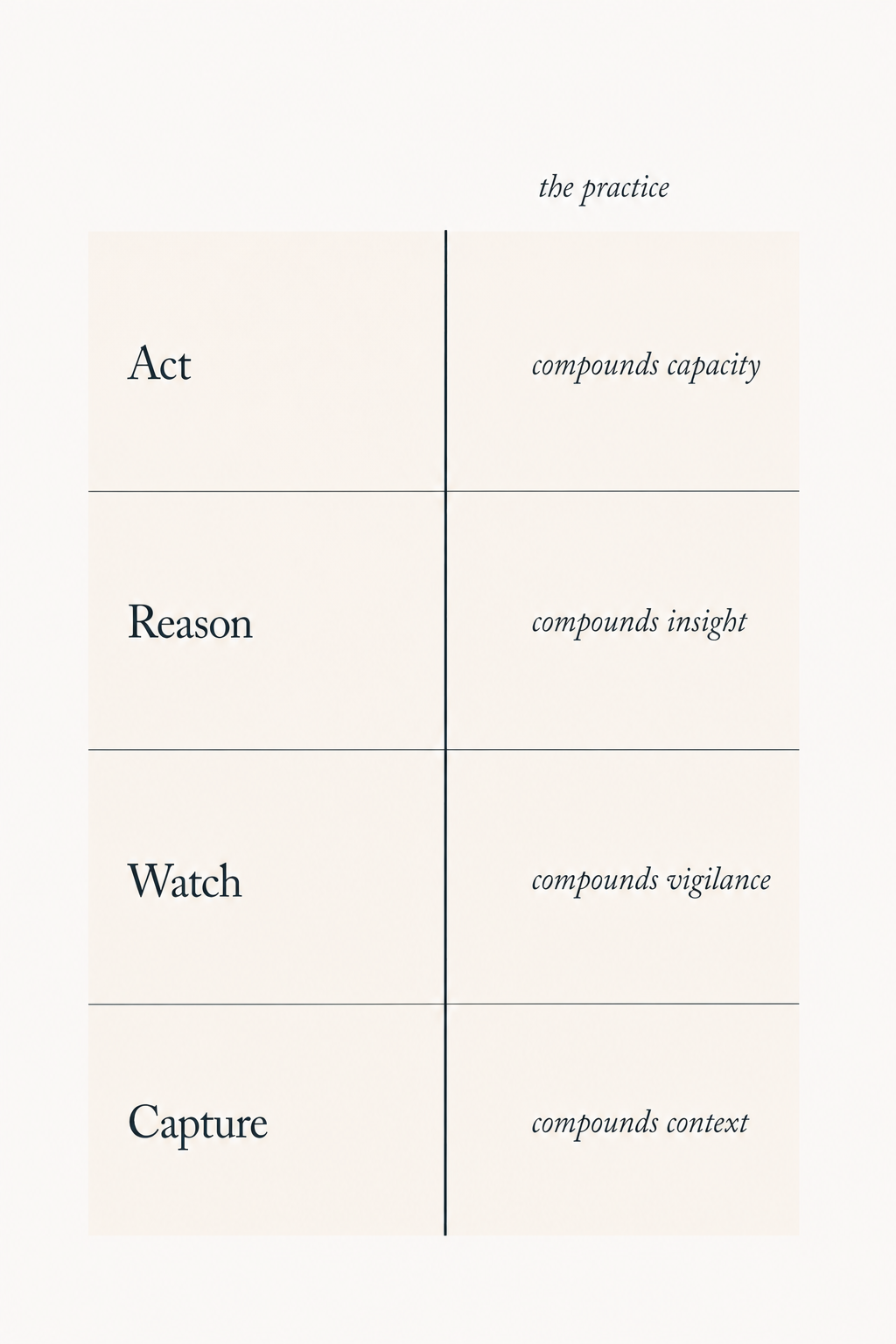
Compounding is not a tool. It is a practice with four layers, each one compounding a different dimension of the operator’s working life. The layers are sequential in description and simultaneous in operation. The practitioner runs all four at once, every day, and the four together produce the effect that no single layer can produce on its own.
The four layers are capture, watch, reason, and act.
Capture
The first layer compounds context.
Capture is the discipline of externalising, daily, the things the operator’s brain has historically been forced to hold. The texture of the call that just ended. The reason a particular decision got made the way it did. The shape of a client’s mood that week. The off-hand remark from a colleague that mattered more than they knew. The judgement that informed a recommendation, before that judgement evaporated into the recommendation itself.
In conventional knowledge work, this material lives in the operator’s head and nowhere else. It is the part of senior expertise that walks out the door on the day the operator does. Capture is the practice that prevents that. The operator dictates a two-minute note after a call. The note is structured, tagged, and stored in a way that makes it findable later, by them or by a system reasoning on their behalf.
The cost of capture is small. The compound on capture is enormous. Each captured node enriches every later query the operator makes against their own history. Six months in, the operator is no longer operating on memory; they are operating on a queryable record of their own working life. A year in, the record itself becomes a thinking partner. The practice has not added work; it has redistributed work from the brain to the system.
Watch
The second layer compounds vigilance.
Watch is the discipline of letting the system surface the things the operator should be paying attention to but cannot, by themselves, track in real time. The commitment that is ageing. The relationship that has gone quiet. The pattern across three separate conversations that the operator did not notice was a pattern. The signal in the inbox that would otherwise be lost in the volume.
The senior operator’s working life produces more signal per day than any single nervous system can metabolise. The conventional response is to triage with willpower: scan the inbox, scan the calendar, hope the important thing surfaces. Watch replaces willpower with structure. The operator defines, once, the categories of signal that matter to them. The system thereafter watches on their behalf and surfaces what fits.
The watch layer is what separates Compounding from automation. Automation removes work from the operator. Watch keeps the operator informed without requiring their attention to be everywhere at once. The operator’s aperture, which under sustained pressure narrows by default, is held open by the system instead of by sheer effort.
Reason
The third layer compounds insight.
Reason is the discipline of putting the captured material to work across time. A captured note is a node. Two nodes connect. A hundred nodes form a pattern. A thousand nodes form a body of judgement that can be queried, reflected on, and synthesised in ways no human memory can perform.
The conventional senior operator reasons against whatever happens to be in their head that day. The Compounding operator reasons against the full body of their captured experience. They can ask, on a Tuesday morning, what the through-line has been across every conversation they have had with a particular client over eighteen months. They can ask which of their commitments are slipping in a way that suggests a pattern. They can ask which of their recent decisions, in retrospect, would be worth revisiting given what they now know.
These are not exotic questions. They are the questions a senior operator should be asking themselves continuously. They are the questions that, without a captured record to reason against, no operator can answer with any rigour. Reason is the layer that makes those questions answerable.
The compound on reason is recursive. Each new insight produced by reasoning becomes itself a captured node, which sharpens the next reasoning pass. The system gets better at reasoning about the operator the longer the operator practises Compounding.
Act
The fourth layer compounds capacity.
Act is the discipline of letting the system carry the load that the operator does not need to carry personally. The follow-up note that drafts itself from the captured record of the meeting. The brief that assembles itself from the relevant prior reasoning. The introduction that the system prepares because it has watched the operator make the same kind of introduction forty times before.
Act is where Compounding produces leverage in the conventional sense, but it is the layer most often misunderstood. The point of act is not that the system does the operator’s work. The point is that the system carries the parts of the work that should never have been on the operator’s nervous system in the first place: the remembering, the sequencing, the reformulating for this specific recipient, the small logistical weight that accumulates across a working day until the operator’s attention has been spent on everything except the work that requires their judgement. Act is the practice of returning that attention to where it belongs.
The operator who runs the act layer well is not the operator who has automated themselves out of their job. They are the operator who has reclaimed the cognitive bandwidth that was being burned on logistics and put it back on the work that actually requires their judgement.
One practice
These are not four tools. They are one practice with four dimensions. The capture layer feeds the reason layer feeds the act layer. The watch layer runs continuously across all of them. Each layer reduces the cognitive load the operator was carrying alone, and each layer compounds value the operator was previously losing.
The practice is portable. The technology that supports it is one expression of the practice, and the technology will change. What does not change is the architecture: capture context, watch for signal, reason across time, act with reduced load. An operator running these four disciplines, daily, is practising Compounding regardless of the tools they use to do it.
This is the shape of the practice. The next question is why it produces appreciating returns rather than depreciating ones, and that is a question about the underlying economics of how AI is priced.
IX. The token-economics argument
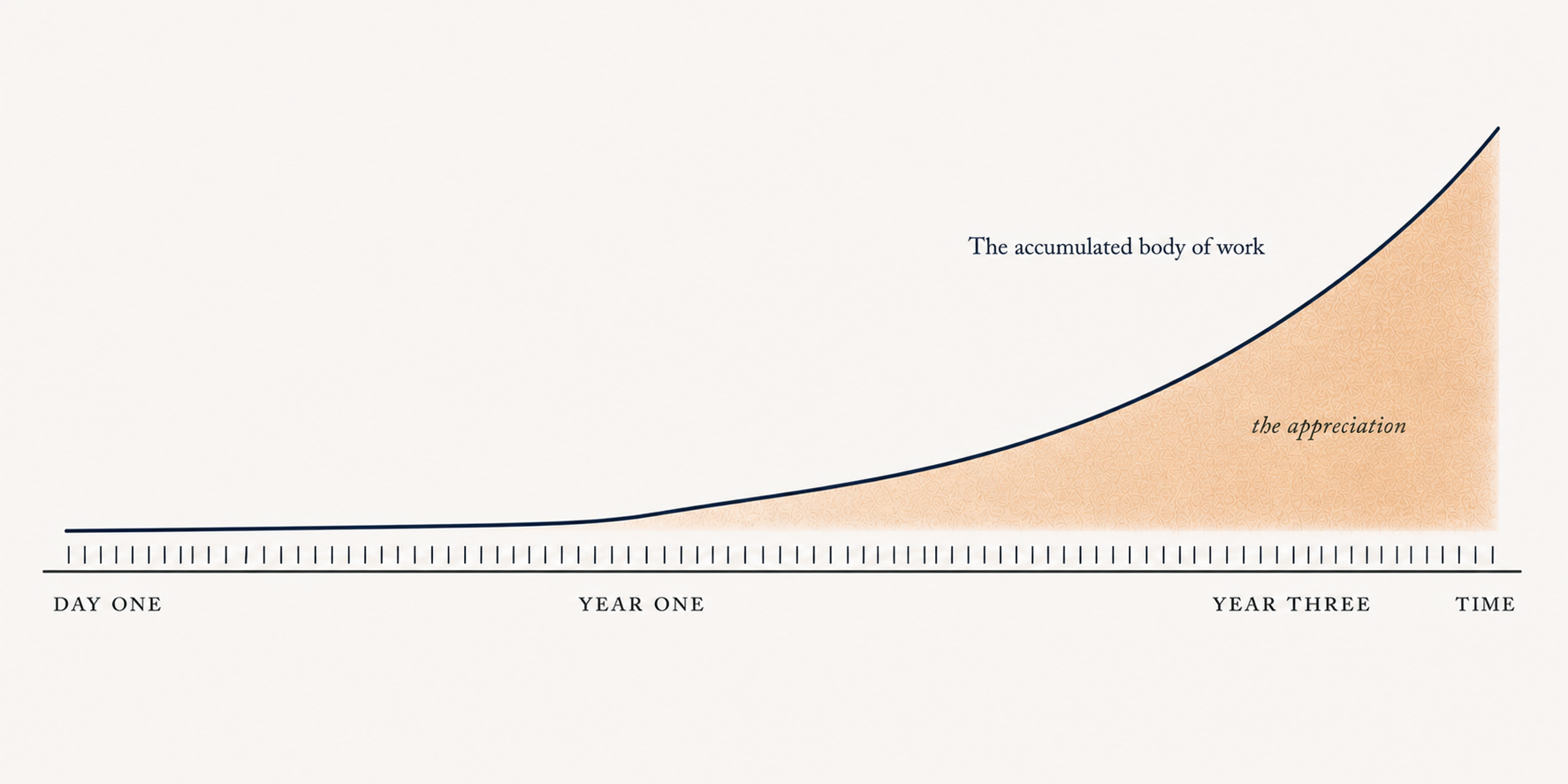
Most AI spend depreciates.
The senior operator with a consumer subscription, a workplace seat, and a few API credentials is currently spending tokens at a rate that compounds against them. Each query produces an output. The output is used, occasionally saved, more often discarded, and the tokens that produced it are gone. The next query starts from the same place the last one did. The system has no memory of what was asked yesterday, no record of which answers were useful, no accumulation of context that would make today’s answer better than yesterday’s. The operator pays again. The system answers again. Nothing builds.
This is not a failure of the technology. It is the economic shape of how most AI is currently used. Consumption is the default mode. Tokens are spent the way money is spent on lunch: the value is realised once, and then it is gone. The operator’s spend is rising; their accumulated body of useful AI work is not. The expense compounds. The asset does not.
Some operators have begun to notice this and have responded by spending less. They are reducing AI usage on the assumption that it is not delivering returns at the rate the spend implies. They are correct about the returns and wrong about the response. The problem is not that they are using AI too much. The problem is that they are using AI consumptively in a context where consumption is structurally a poor deal.
Compounding is the practice that changes the economic shape of AI spend.
The mechanics are straightforward and worth being precise about. Each act of capture, in the practice, produces a structured node in the operator’s accumulated body of work. The node is small. The cost of producing it is a few tokens of dictation, a few more of structuring, a few more of indexing. By itself, the node is worth almost nothing. Most of them, individually, will never be queried directly.
What changes the economics is what happens when the nodes accumulate. A query against ten captured nodes returns one answer. The same query against ten thousand captured nodes returns a different answer, drawn from a body of context the operator has built across years. The second query did not cost more than the first. The tokens spent on the query itself are roughly identical. What differs is the value of what comes back, and the difference is structural: each prior captured node has made every future query incrementally more valuable, at no additional cost to the query.
This is the appreciating asset that consumptive AI spend cannot produce. The captured body of work compounds, in the strict mathematical sense. Each new deposit raises the value of all prior deposits, because each prior deposit becomes more findable, more connectable, and more useful in the context of the new one. The math is the same math that makes a savings account compound. The principal is the operator’s captured context. The interest is the increasing value the captured context produces over time, in answers, in syntheses, in pattern recognition the operator could not perform without the accumulated record.
The practitioner who has been Compounding for three years is not paying more per token than the operator who started yesterday. They are paying the same. They are getting back, per token, an order of magnitude more value, because the same query against their captured body of work returns a richer answer. They have, in effect, lowered their unit cost of useful AI by raising the value of the substrate they are querying against.
This is the only operator-side AI practice that produces appreciating returns on token spend. Every other approach is a variation on consumption: prompt better, switch models, automate more aggressively. None of these change the underlying economic shape. The tokens spent today are still gone tomorrow. The body of work is not building.
Compounding is the practice that makes the body of work build.
The senior operator who began with the diagnosis (the scissors, the deflation of cognitive labour, the depreciating value of expertise) is now in possession of the response. The response is not to spend less on AI. It is to spend the same amount, structured to appreciate. Most AI spend depreciates. Compounding is the practice that makes it appreciate.
The next question is what kind of practice this actually is, and that is a question about category.
X. The category claim
Compounding is a new category of practice.
It is not a productivity methodology. The productivity methodologies were built for a labour market that rewarded individual output, in which the operator’s job was to produce more per unit of time. The current condition is not a productivity problem. The operator is already producing enough. The market is re-pricing the output, not asking for more of it.
It is not a flavour of personal knowledge management. The knowledge management traditions, valuable as they are, were built around the question of how the individual organises what they already know. Compounding addresses a different question: how the individual builds an accumulating, queryable, appreciating body of work that holds them steady while the labour market underneath them deflates. The two practices may share tooling. They do not share purpose.
It is not performance psychology. The psychology trains the operator’s mind. Compounding trains the system around the mind. The two are complementary; neither is the other.
It is not an AI workflow. Workflows are about automating tasks. Compounding is about constructing an asset. The tokens are spent in service of the asset, not in service of the task. None of the adjacent disciplines is wrong. None of them is enough.
Compounding is what the senior operator does when they recognise that the post-Keynesian system is no longer running the bargain it ran for their parents and themselves, that the deflation of cognitive labour is structural rather than cyclical, and that the response will not come from policy or from the labour market but from the operator’s own daily practice. It is the discipline of externalising context, holding vigilance, reasoning across time, and acting with reduced cognitive load, every day, for years, until the accumulated body of work produces returns the operator could not have produced from their nervous system alone.
The practice deserves practitioners. The practitioners deserve the company of others who recognise the condition and have begun the work.
This essay is the opening statement. The manifesto follows. The book follows that. Anyone who has read this far and recognised themselves in it is already, in some small way, practising.
The scissors will keep closing. The practice is what makes the closing survivable.
This essay is the opening artefact of a longer project. The manifesto follows; the book follows the manifesto.
To receive updates on the Compounding practice: .
For consultancy enquiries on operating model and AI-age positioning, contact.