
Essay · Organizational capability
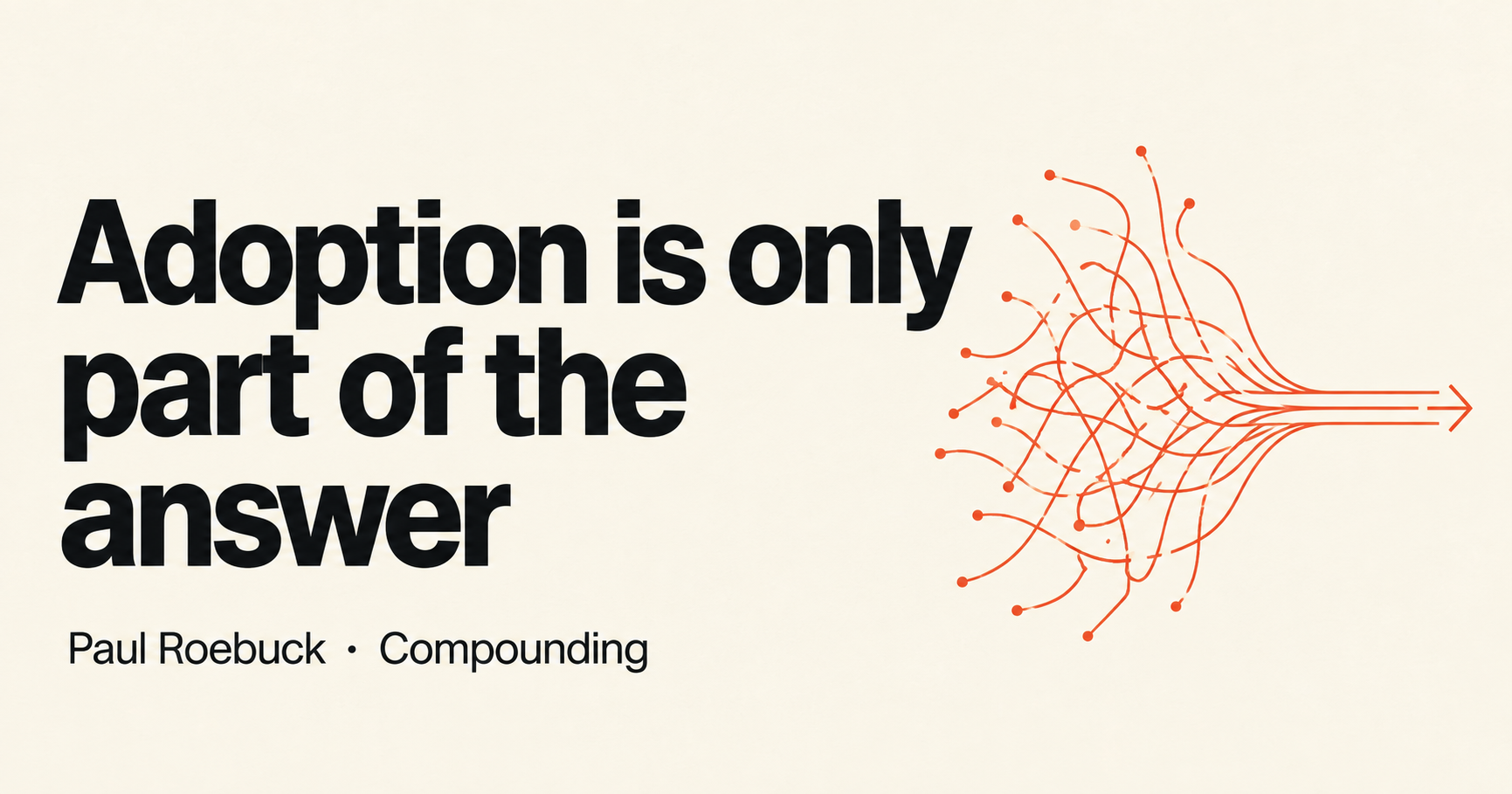
Adoption is only part of the answer
Using AI is only part of the work. What changes for your customers because you do?
“Companies that use AI will replace companies that don’t.”
It is a familiar warning. It also makes adoption sound like the source of advantage. Adopting AI is only part of the work.
The other part is redesigning how the organisation works so that what the technology makes possible becomes something customers value. A company can generate more analysis, produce more ideas and automate more activity without giving anyone a better reason to choose what it produces.
Imagine a leadership team looking at a convincing piece of customer research. People would value an offer that is easier to understand, easier to buy and more dependable to use. There is agreement around the table. Then the conversation turns to what would have to change.
The product team would need to alter its priorities. The commercial team would have to reconsider pricing. Operations would need capacity that is already committed elsewhere. Each has a reasonable concern, and each is accountable for a different part of the result. Better understanding has revealed an opportunity. Delivering it requires decisions about how the business will work.
That is the challenge behind my latest field note, More Intelligence. Better Reasons to Choose?. Technology alone is not the answer. Its value depends on the enterprise's capability to turn what it makes possible into a benefit people can experience.
Artificial intelligence makes this increasingly consequential. Research can become easier to interrogate. Patterns can become easier to investigate. More potential responses can be developed and compared. Where the evidence is sound, that can improve the choices available to a business. But if understanding develops faster than the company can change its priorities, commit resources and act, the gap between possibility and delivery can grow.
There is evidence that how the work changes matters. In its March 2025 survey, McKinsey found that workflow redesign had the strongest association with reported financial impact from generative AI among the 25 organisational attributes it examined. That does not establish causation, but it gives us reason to look beyond adoption when asking where value comes from.
I think there are three responsibilities leadership has to bring together here: choosing the customer benefit, enabling the organisation to deliver it and establishing what the result should teach it.
The first sounds straightforward, but it requires precision. A deeper relationship may be valuable in some categories. In others, people want a reliable product that is easy to find and buy. A financial services customer may value greater confidence about an important commitment. A business buyer may need several capabilities to work together around a result. These ambitions ask different things of the enterprise.
The benefit needs to be clear enough to guide a choice between competing uses of resources. "Understand our customers better" describes an ambition for knowledge. What would customers actually experience differently if that ambition succeeded?
Zara offers a concrete illustration. In its 2014 annual report, Inditex describes introducing technology to track individual garments and redesigning store workflows around it. Staff could check whether an item was available in their store, another store or online. The company reported that the time needed for replenishment fell by half.
The customer benefit was straightforward: helping someone find and buy the item they wanted. Better information became useful through changes in how the work was done. This example predates generative AI, but I think it illustrates the organisational task that abundant intelligence makes more pressing.
The second responsibility is making the commitment possible across the business. A shared ambition still needs someone able to resolve competing priorities, people with the capacity to do the work and measures that recognise the intended result. Otherwise, collaboration can depend on individuals doing the right thing despite what their own objectives reward.
This does not mean every opportunity calls for a reorganisation. Sometimes the necessary change is quite specific: a different investment priority, a clearer decision right or an agreement about how the cost and benefit will be shared. The important point is to make those choices part of the proposal. "The teams will work together" leaves too much unresolved.
Technology can help here too. It can make relevant information easier to share, reduce coordination work and support faster decisions. The question is whether its deployment changes the conditions that constrain delivery. If the constraint is a disagreement about priorities, a faster analysis will only help if leadership uses it to settle that disagreement.
The third responsibility is deciding what will count as progress and retaining what is learned. Did more people choose the product? Did the intended experience improve? Was the benefit worth the cost of delivering it? The appropriate evidence will differ by category, but completing the initiative is only the beginning of answering those questions.
A disappointing result should help the company distinguish between an opportunity it misunderstood and an offer it failed to deliver well. A successful result should leave it with knowledge it can use again. Either way, the next decision should begin with more than another presentation and a fresh set of assumptions.
For a company to turn better understanding into better reasons to choose, three things have to be true:
- The customer benefit is clear enough to guide investment. The organisation can say what people should experience differently, why it matters and which choices will determine whether it happens.
- The organisation is equipped to deliver it. The relevant knowledge, authority, resources and incentives come together around those choices, with a way to resolve the trade-offs.
- The result makes the company more capable. It can judge what happened, retain what it learned and use that knowledge to improve the next decision.
A useful starting point is a consequential decision the organisation makes repeatedly. That is where understanding has to become a commitment: what to offer, where to invest or what to change for customers. Examining a real decision brings the relevant evidence, competing priorities and authority into view. It gives the company something specific to improve and a result it can judge.
The decision needs to matter enough that improving it would make a difference. Repetition matters too: what the organisation learns from one decision should improve the next. It can begin with a defined change, test the result and retain what it learns. Over time, that is how better understanding can become a capability the business can rely on.
Adoption is only part of the answer. The question for leadership is what customers will have a better reason to choose because of it.
Where is the connection between better understanding and better delivery proving hardest in your organisation? I would be interested to hear. You can reply directly to this letter.
Paul
Receive the next argument.
Essays and field notes for leaders building through the machine age.